

The Standard Travels: Operational Excellence in Food Service

Felipe Borja
Co-founder & CEO
Introduction
The morning checklist at a location in Concepción should be the same as the one running in Santiago, Antofagasta, and every other store in the chain. In practice, it is not. One location works from a binder printed last year. Another uses a notebook the shift lead designed themselves. A third runs through a WhatsApp group that nobody archives. The standard was defined once at headquarters, but by the time it reaches the farthest location, it has been rewritten three times — once by whoever remembered it differently, once by whoever did not have the latest version, and once by whoever was covering a shift they were never trained for.
This is not a training problem. It is a portability problem. The standard does not travel.
When a chain runs ten, twenty, or fifty locations, operational excellence is not about finding better procedures. It is about making sure the same procedure executes the same way at every location, every shift, whether the health inspector walks in tomorrow or next quarter. That is what this guide covers: how to build a standard that travels, and how a connected operations platform supports that execution with mobile tools, photo evidence, and escalation paths that close the loop when something breaks.
The Problem: When Operational Excellence Depends on Memory
Most food service chains manage their standards through a mix of printed binders, emails from the corporate chef, and handwritten notes. The intention is good — the standard exists. The execution breaks because the medium does not move.
A binder stays in the back office. An email lands in an inbox someone has not opened. A WhatsApp message scrolls past and is gone by lunch.
The team at headquarters updates the checklist with a new temperature threshold or a changed allergen procedure. They send it out. Six weeks later, during an internal visit, they find the old threshold still posted on the wall. Nobody meant to ignore the update. The binder just never got replaced.
This is the real cost of disconnected standards: not that the standard is wrong, but that the gap between what is defined and what is executed grows with every location added to the chain. A single-location operation does not have this problem — the owner or manager sees every shift. The gap appears with the second location and widens with every one after that.
What Operational Excellence Actually Requires
Operational excellence across multiple locations demands three things that printed documents and messaging apps cannot deliver together:
The check must be the same everywhere. Not approximately the same. Not the same unless someone remembers to print the latest version. The same, running from a single source that every location accesses the moment the check opens.
The response must carry evidence. A checked box on paper can be filled in at the desk five minutes before the inspector arrives. A photo of the actual temperature reading, taken inside the cooler during the round, cannot. Evidence transforms a checklist from a compliance exercise into an operational record.
A deviation must trigger a response, not a note. When a crew member finds a cooler reading 2°C above the limit, writing it down in a notebook is not a response. The response is an escalation that reaches someone who can act before the product is at risk. The chain between finding the problem and fixing it has to be part of the standard itself, not something left to each location's initiative.
These three capabilities — standardized execution, in-field evidence, and connected escalation — are what turn a checklist into a standard that actually travels.
Templates: How the Standard Becomes Portable
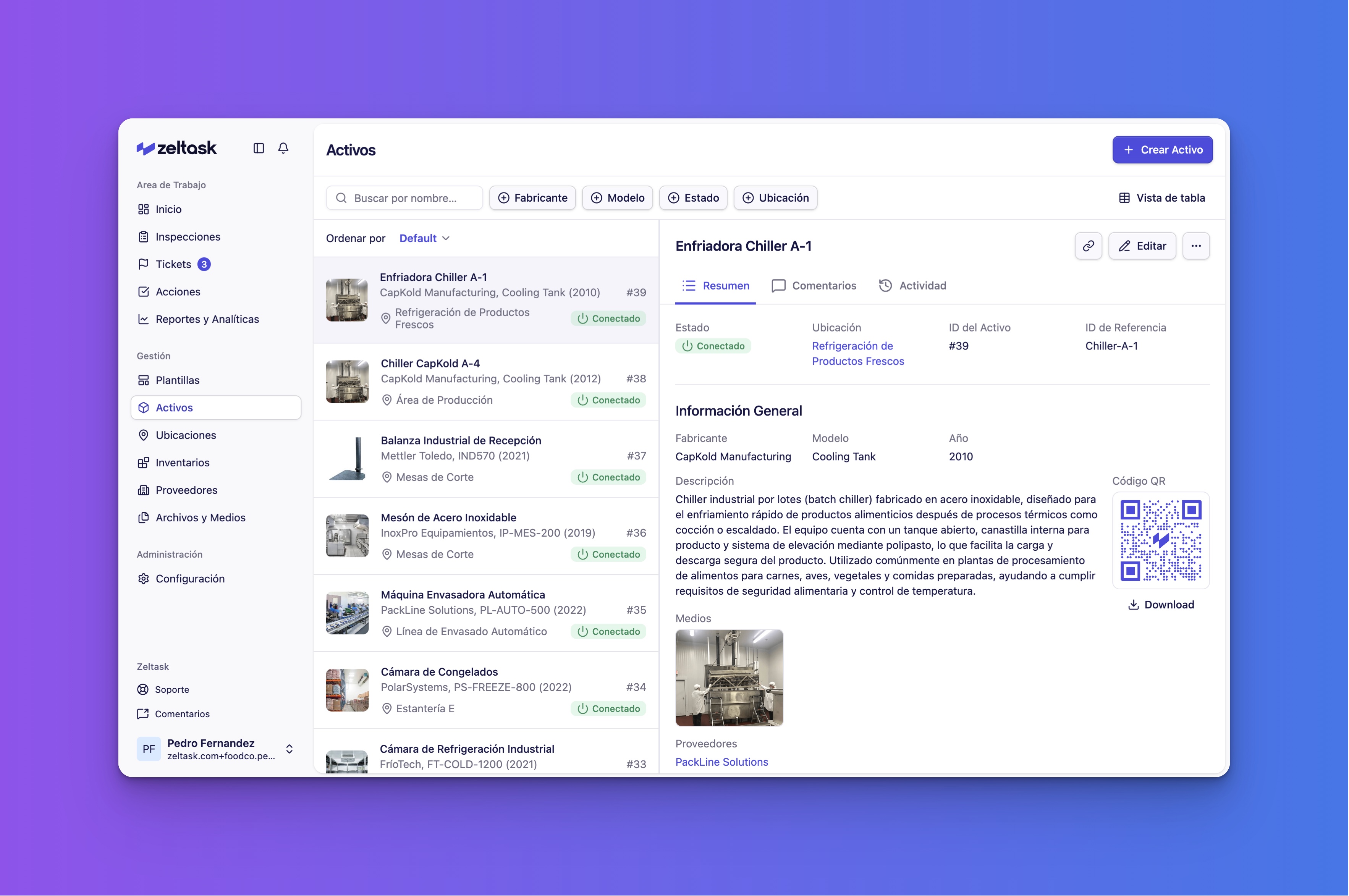
The foundation of a traveling standard is a single template created once and used everywhere. Zeltask's Template Builder lets a corporate chef, quality manager, or zone supervisor build the complete checklist — every question, every temperature range, every allergen check — in one place. The same template then runs across every location, on mobile, with no local editing and no version drift.
A template is not a static document. It supports multiple question types — numeric fields for temperatures, Yes/No/N.A. for allergen checks, single and multiple selection for equipment status, date and time for log entries. Fields can be configured with logic: if a temperature reading falls outside the acceptable range, a follow-up question appears automatically, asking for the corrective action taken.
This means the crew member in Concepción opens the same checklist as the crew member in Antofagasta, with the same questions in the same order, the same acceptable ranges, and the same required evidence fields. The standard is not a document that sits in a binder. It is a live execution that travels to every location.
Mobile execution matters here because the work happens on the floor, not at a desk. The crew member carries a phone through the kitchen, the cooler, the prep area, and the storage room. Each check is completed at the point of verification. Photos are taken at the moment a condition is observed. Temperature readings are entered as the thermometer is read. The separation between the check and the record collapses — the execution is the record.
Evidence That Survives the Visit
One of the clearest signs of a disconnected standard is the gap between what gets checked and what can be verified later. A paper checklist filled in at the start of a shift and signed at the end tells an inspector that someone intended to check. A digital record with a photo timestamp and a deviation note tells the inspector what was actually found and what was done about it.
Photo evidence, attached during the checklist execution, creates a visual record that survives between shifts and between store visits. A photo of the cooler display at 4°C is not a claim that the temperature was checked — it is the evidence. A photo of a cleaning surface during the closing round shows the condition at the moment it was verified, not a memory of what it looked like.
This is the difference between compliance as a paperwork exercise and operational excellence as a practiced discipline. One produces files for the auditor. The other produces data a manager can use between audits to see where the standard is holding and where it is slipping.
When the Standard Breaks: Escalation That Works
A standard that only checks is half a standard. The other half is what happens when a check finds something wrong.
In a paper-based system, a deviation gets written in a notebook or mentioned at shift handover. Whether it reaches someone who can act depends on memory and initiative. The person who notices the problem is often not the person authorized to fix it. The location calls headquarters, leaves a message, hopes someone follows up.
A connected standard closes that gap by design. When a crew member finds a deviation — a cooler reading outside range, a missing allergen label, a surface that did not pass the ATP swab — the response is built into the check itself. The deviation flags an automatic escalation. The system creates a corrective action, assigns it to the responsible person or team, and tracks it until it is resolved.
The escalation is not an extra step. It is part of the same workflow the crew member is already completing. The deviation is found, recorded with evidence, and escalated without leaving the mobile check. Headquarters sees the alert the same day, not the same month.
This is what makes the standard actually enforceable across distance: the loop that runs from check → deviation → escalation → resolution belongs to the system, not to a phone call that might not happen.
What This Approach Does and Does Not Do
A platform like Zeltask supports the execution and the record of the standard across multiple locations. It helps ensure the same check runs the same way everywhere, that evidence is collected during execution, and that deviations reach the right people automatically. It does not issue a certification, and it does not replace HACCP plans, audits, or the people who run them. The standard still has to be defined by people who know the operation. The local team still has to execute it. The compliance visit still comes.
What changes is the gap between what was defined and what was done. When the standard travels through a connected system instead of a binder, the distance between headquarters and the farthest location stops growing every time a new location opens.
Where to Start
For a food service chain running multiple locations, the first step is not a platform implementation. It is a single decision: which checklist travels first. Pick one check — the daily opening round, the cooler temperature log, the closing sanitation verification — and build it as a template. Roll it out across two locations for two weeks. Compare what comes back: the same data from both locations, with evidence, and a clear picture of where the standard is holding and where it needs adjustment.
From that baseline, the second location becomes a copy, not a rewrite. The third one, and the tenth, and the fiftieth.
Conclusion
A standard that lives in a binder degrades with every location the chain adds. A standard that runs as a template — executed on a mobile device, with evidence captured at the point of verification and deviations that escalate on their own — arrives at the fiftieth location exactly as it left headquarters. What changes is not the standard. It is the distance it can travel without losing anything.
Ready to see how connected operations work in practice for your food service locations? Schedule a demo.
Written by
Felipe Borja
Co-founder & CEO
Felipe Borja studied Business Administration at Adolfo Ibáñez University in Chile and earned an MBA from Leipzig University in Germany. At Zeltask, he is responsible for everything related to marketing and working with our clients.
Related Posts

Lean Six Sigma Belts: A Practical Guide for Manufacturing Teams
Lean Six Sigma belts define how manufacturing teams structure improvement work — from frontline awareness to enterprise-wide strategy. Learn what each belt level does, who it is for, and how to match roles to your plant's real challenges.

Connected Frontline Teams: How to Bridge the Digital Gap in Manufacturing
Most digital transformation strategies overlook the people who matter most — frontline teams. Learn what connected frontline workers really means, why the gap between factory systems and shop floor teams persists, and how to close it with practical steps and the right platform.

Causal Factors: Prevent Recurring Problems in Manufacturing
Causal factors are the conditions and actions that directly contribute to manufacturing problems. Learn how to distinguish them from symptoms and root causes, identify them on the shop floor, and use them to build corrective actions that actually stick.