

Audits and Corrective Actions: A Processing Plant Guide

Felipe Borja
Co-founder & CEO
Introduction
A deviation is flagged during a morning inspection on the CIP skid in the pasteurization hall. The operator logs it, finishes the shift, and the note lands in a binder. Three weeks later, when the HACCP auditor asks for the corrective action, a quality lead pulls the binder, searches for that entry, tries to remember which machine it referred to, and pieces together what happened. The gap between the finding and the fix is what audits reveal.
That scene is not the exception. It is how most processing plants handle non-conformities today — a chain of disconnected records held together by memory. Every plant that passes a HACCP or ISO 22000 audit has some version of this process. The ones that fail it have the same process, just with worse luck when the auditor chose which trail to follow.
Why Audits Expose Weak Corrective Actions
HACCP and ISO 22000 require a closed loop: every non-conformity needs a documented corrective action, and that action needs evidence of completion. In many processing plants, the non-conformity and its corrective action are created in separate places — the NC lives in an inspection log or a paper checklist, the corrective action lives in a spreadsheet, an email thread, or a maintenance whiteboard.
When the auditor reviews the trail, someone has to connect those two records manually. That is where gaps appear: a missing date, a wrong asset name, a description so vague it could apply to any machine. The corrective action may list "re-calibrated sensor" without saying which sensor, on which production line, or whether the calibration was verified afterward. The question "what was done about the temperature deviation on the heat exchanger on June 10" should have a clear answer. In most plants, finding that answer takes a search across three systems and a call to the shift lead from that week, assuming that person is still on the same shift or still works at the plant.
The weakness is not the corrective action itself. It is the distance between the evidence and the record of what was done about it. During a process audit, that gap is where findings appear. When that distance is closed only during audit prep, the trail is only as strong as the memory of the person who reconstructed it.
How Plants Manage the Corrective-Action Workflow Today
Most processing plants run corrective actions through disconnected channels: a whiteboard in the quality office, a WhatsApp group between the maintenance lead and the shift supervisor, an email chain when something needs a signature. The non-conformity may be captured on a paper checklist, a QR-code scan at the machine, or a standalone inspection tool. The corrective action lives somewhere else — if it is written down at all.
When the audit approaches, connecting each non-conformity to its corrective action means walking the same channels backwards. Someone opens the inspection binders, finds the deviation entries, looks for the corresponding action in a different log, and hopes the two still match. The time pressure of audit prep turns this into a scramble. Records get backdated to the day of the NC rather than the day of the review. Photographs that were taken weeks ago get dug out of personal phones or messaging apps. The auditor has no way to tell which links are original and which were assembled to fill a gap.
This is not a failure of effort. It is a structural problem: the corrective action was never designed to hold the evidence of what triggered it. The two records exist in different formats, different systems, and different hands. No one decided that they should live apart — it happened one paper form, one spreadsheet, one workaround at a time. But the result is the same: when the auditor asks for the connection between a deviation and the action taken, someone has to build it from scratch under time pressure that makes mistakes more likely than accuracy.
What Audits Look Like When Corrective Actions Are Born Linked
When a corrective action is created from the deviation itself, the link is not reconstructed — it is inherited. This is the difference between traceability that has to be built after the fact and traceability that is built when the work happens.
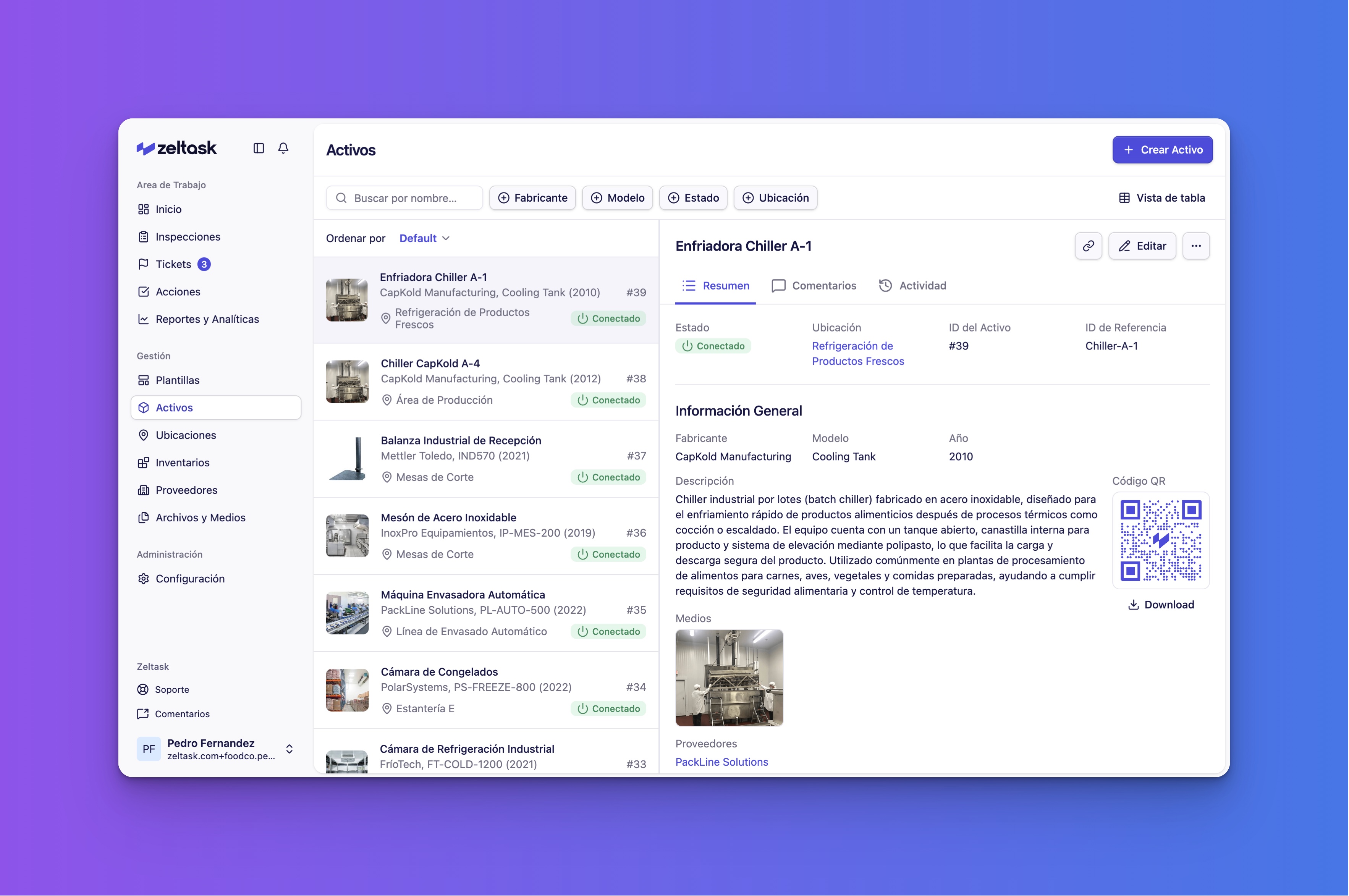
In practice, it works like this. An operator or inspector flags a deviation during an inspection executed through Zeltask's Inspections module. The deviation is captured with a photo, a note, and a reading — all attached to the specific asset and location. From that inspection result, a corrective action is created directly in the Actions module with a single step.
That corrective action inherits everything: the asset it belongs to, the location where it was flagged, the inspector who flagged it, the timestamp of the original finding, and the evidence that triggered the action. The responsible technician receives the action with the full context already attached — they do not need to figure out which machine or which shift the deviation refers to.
The Actions module tracks the corrective action through its lifecycle: Open, In Progress, Done. The technician adds costs, spare parts, photos, and completion notes. The timeline is preserved automatically. Every field was filled during the work, not during a prep session the night before the audit.
This is the difference between a record that was written when it happened and a record that was reconstructed when someone asked for it. The first one holds up under scrutiny because it was never meant to do anything other than describe what really occurred. The second one holds up only as long as the person who built it remembers what the auditor was looking for.
This is what traceability by construction means on the plant floor.
From Deviation to Corrective Action on the Plant Floor
A concrete example makes the difference clearer. Consider a processing plant that runs daily CIP (clean-in-place) verification inspections on its heat exchangers and pasteurizers.
During a morning inspection on the HTST pasteurizer, the inspector finds a temperature reading outside the validated range. They capture the deviation on their phone: a photo of the control panel reading, a brief note describing the symptom, and a mandatory checkbox confirming the asset — the pasteurizer — and the location — the pasteurization hall. The inspection is saved and the deviation is flagged.
From that flagged deviation, a corrective action is created. The action inherits the pasteurizer as its linked asset, the pasteurization hall as its linked location, and the inspector's profile as the reporter. The action type is set to Reactive, the priority to High. It is assigned to the maintenance lead.
The maintenance lead opens the action on their phone. They see the temperature reading, the inspector's note, and the photo — all attached without anyone having to forward anything. They schedule a re-calibration of the temperature sensor, add a spare part from the inventory module, and close the action with a photo of the completed calibration and a sign-off note. Every step is timestamped by the system, not typed in from memory.
Later, when the quality supervisor reviews the closed action, they see the full chain: the initial deviation, the evidence, the corrective action, the spare part used, and the completion sign-off — all in one place. No one had to ask the maintenance lead what happened or whether the calibration was actually done. The record speaks for itself because it was built from the work, not from a conversation about the work.
The record now contains:
- Who flagged the deviation (the inspector)
- When it was flagged (the inspection timestamp)
- On which asset (the HTST pasteurizer)
- At which location (the pasteurization hall)
- What the evidence showed (the photo and reading)
- What corrective action was taken (sensor re-calibration)
- Who performed it (the maintenance lead)
- When it was completed (the action closure timestamp)
Every piece of information an auditor could ask for is already in the trail. Nothing had to be reconstructed.
What Changes at Audit Time
The difference shows up when the auditor asks for corrective-action records for the last quarter. Instead of pulling binders, cross-referencing spreadsheets, and calling shift leads, the quality manager opens a single view in Zeltask's Reports and Dashboards. Every non-conformity is listed with its linked corrective action, its evidence, and its completion status.
The search that used to take a full afternoon now takes a few clicks. The quality manager does not need to remember which binder the May deviations are in or which shift lead handled the June heat exchanger issue. Every corrective action in the system is visible from a single screen, filtered by asset, by date, by status, or by inspector. The link between the NC and the corrective action is not hidden in a separate file — it is a field in the same record.
The auditor can trace from any deviation to the action that addressed it, and from any action back to the inspection that triggered it. That connected view helps teams focus on preventing recurring problems instead of patching the same issue twice. The links are verified because they were created when the work happened — not reconstructed under time pressure.
Preparation that used to take days takes minutes. The plant arrives at the audit with a trail that is complete, chronological, and connected by design.
Conclusion
A platform like Zeltask supports the execution and the record. It does not issue a certification, and it does not replace HACCP plans, audits, or the people who run them. What it does is close the distance between every deviation and its corrective action — not during audit prep, but when the work happens. That difference is what turns a trail that has to be reconstructed into a trail that is already written.
Ready to see how connected operations work in practice? Schedule a demo.
Written by
Felipe Borja
Co-founder & CEO
Felipe Borja studied Business Administration at Adolfo Ibáñez University in Chile and earned an MBA from Leipzig University in Germany. At Zeltask, he is responsible for everything related to marketing and working with our clients.
Related Posts

What Is a Process Audit? A Complete Guide for Manufacturing Teams
Process audits evaluate how work is actually performed on the shop floor—not just the final output. Learn the different types, their benefits for manufacturing teams, and how digital tools turn audits into a driver of continuous improvement.