

What Is Kaizen Culture? Building Daily Improvement Habits in Manufacturing

Felipe Borja
Co-founder & CEO
Introduction
In manufacturing, investing in automation, equipment, and digital tools is only part of the equation. The way people at every level think about and approach their work matters just as much. When improvement depends on special projects or periodic workshops, the gains rarely last — and old habits return the moment the initiative ends.
Kaizen culture offers a different path. It embeds continuous improvement into daily routines, empowering frontline teams to identify problems, test solutions, and build better practices — one shift at a time. This guide explains what kaizen culture means, how to build it step by step, the tools that sustain it, and why connected operations platforms make the difference between temporary efforts and lasting change.
What Is Kaizen Culture?
Kaizen — a Japanese term meaning "change for better" — represents an organizational mindset where everyone, from operators to plant leaders, shares responsibility for improving processes. In a kaizen culture:
- Issues are treated as improvement opportunities, not failures
- Small, incremental changes are prioritized over large, disruptive overhauls
- Improvement happens where work is done — on the shop floor
- Frontline workers are encouraged to learn, experiment, and voice their observations
Unlike top-down improvement initiatives, kaizen culture takes a bottom-up approach. It empowers operators, technicians, and supervisors to spot inefficiencies, waste, and safety risks as part of their daily routines. Even modest improvements — better ergonomics at a workstation, a reduced motion sequence, a clearer inspection checklist — generate significant cumulative benefits when repeated across lines, shifts, and facilities.
The result is a workplace where improvement is not an event but a habit.
How to Build a Kaizen Culture in Manufacturing
Building kaizen culture does not happen overnight. It requires deliberate effort across several dimensions.
Start with Leadership Commitment
Leaders set the tone. When supervisors and managers regularly visit the shop floor, observe work being done, and engage with frontline teams, they signal that improvement matters at every level. These shop floor walks — sometimes called Gemba walks — demonstrate commitment through presence, not just policy.
Leaders who ask questions, listen to concerns, and act on feedback create an environment where continuous improvement can take root.
Align Improvement with Operational Goals
Kaizen efforts deliver the most value when they connect to core objectives: safety improvement, defect reduction, on-time delivery, waste reduction, and equipment reliability. Without this alignment, improvement activities risk becoming disconnected from the outcomes that matter.
Frontline teams should understand how their improvements contribute to broader plant performance. This connection gives purpose to daily improvement work and makes results measurable.
Empower Frontline Teams
The people closest to the work are in the best position to identify opportunities for improvement. Kaizen culture requires giving operators and technicians clear ways to raise concerns, submit improvement ideas, and participate in problem-solving.
This means providing simple channels for capturing observations, setting aside time for problem-solving between shifts, and ensuring that ideas are acknowledged and acted upon — not just collected.
Standardize the Improvement Process
Without structure, improvement efforts become chaotic. A consistent kaizen workflow keeps the process disciplined:
- Identify the problem — What is happening? Where?
- Analyze root causes — Why is it happening?
- Test a solution — What change could work?
- Standardize what works — How do we make this the new norm?
- Share the learning — Who else can benefit?
This structure mirrors the continuous improvement model that effective manufacturing organizations follow: a repeatable cycle where each improvement builds on the last.
Build Skills Through Practical Training
Teams need practical capabilities to sustain kaizen culture. Training should cover structured problem-solving techniques, root cause analysis methods, waste identification, and standard work development.
The most effective training is hands-on and application-based. Teams learn best by solving real problems on their own shop floor, not by studying theory in a classroom.
Recognize and Reinforce Improvement Behavior
Sustainability requires reinforcement. Acknowledge ideas during daily meetings — not just successful outcomes, but also the effort of identifying problems and proposing solutions. Share improvement stories across teams. When people feel that their contributions are valued, improvement gradually becomes a natural part of how work gets done.
Kaizen Events vs. Daily Kaizen Culture
Many manufacturing teams are familiar with kaizen events — focused workshops where cross-functional teams work intensively on a specific problem for several days. These events can deliver quick results: visible improvements, cross-functional collaboration, and momentum.
However, kaizen events alone are not enough to build lasting culture change. After the event ends, old habits often return because:
- Participation is limited to a small group
- Improvements may be temporary without ongoing reinforcement
- Teams may see improvement as "special work" rather than daily work
The shift from occasional events to a daily kaizen culture happens when:
- Problem identification becomes part of routine work, not a separate activity
- Small improvements happen frequently, not just during formal events
- Teams review progress regularly during daily or shift meetings
- Follow-up on improvement actions is consistent and visible
Kaizen events remain valuable as accelerators, but sustainable culture requires improvement to be embedded in everyday operations.
What Kaizen Culture Looks Like on the Shop Floor
When kaizen culture takes hold, the shop floor changes in tangible ways:
Increased Safety — Workers proactively identify hazards and near-misses. Workstations become cleaner, safer, and more ergonomic. Compliance improves and incident rates decrease.
Better Quality and Less Waste — Problems are addressed at their source. Fewer defects and less rework mean less scrap and fewer customer complaints. Quality becomes a frontline responsibility, not just a department function.
Greater Equipment Reliability — Operators detect equipment issues early, making preventive maintenance more effective and reducing unplanned downtime. When machines run reliably, production becomes stable and predictable.
Stronger Employee Engagement — When people see that their ideas are valued and implemented, engagement increases. Teams take ownership of their processes, productivity improves, and retention strengthens.
Higher Resilience — Organizations with strong kaizen cultures adapt more effectively to new products, volume fluctuations, and process changes. Continuous improvement builds the adaptive capacity that manufacturing operations need.
Tools That Support Kaizen Culture
The right tools provide structure and consistency for kaizen efforts.
Problem-Solving Tools
Structured problem-solving prevents issues from recurring. Techniques like the 5 Whys, PDCA (Plan-Do-Check-Act), A3 problem-solving, and fishbone diagrams guide teams through disciplined thinking — from problem identification to verified solution.
Standard Work
Standard work defines the current best way to perform a task: clear steps, safety considerations, and quality checkpoints. Standardization reduces variation, makes processes measurable, and provides the baseline from which improvement begins. Process audits verify that standard work is consistently followed across shifts and teams.
Waste Reduction Frameworks
Frameworks like 5S (Sort, Straighten, Shine, Standardize, Sustain) create organized, safer workstations. Value stream mapping identifies waste across entire processes. These approaches complement kaizen culture by giving teams structured methods for finding and eliminating non-value-adding activities.
Measurement and Feedback
Measuring impact reinforces improvement behavior. Metrics like downtime reduction, cost savings, safety incident rates, quality improvements, and employee participation rates provide evidence that kaizen efforts are working. Clear feedback loops help teams understand what to prioritize next.
How Connected Operations Platforms Sustain Kaizen Culture
Connected operations platforms address the structural challenges that cause many kaizen initiatives to fade. They provide the visibility, accountability, and consistency that paper-based systems cannot match.
Capture Ideas Where Work Happens
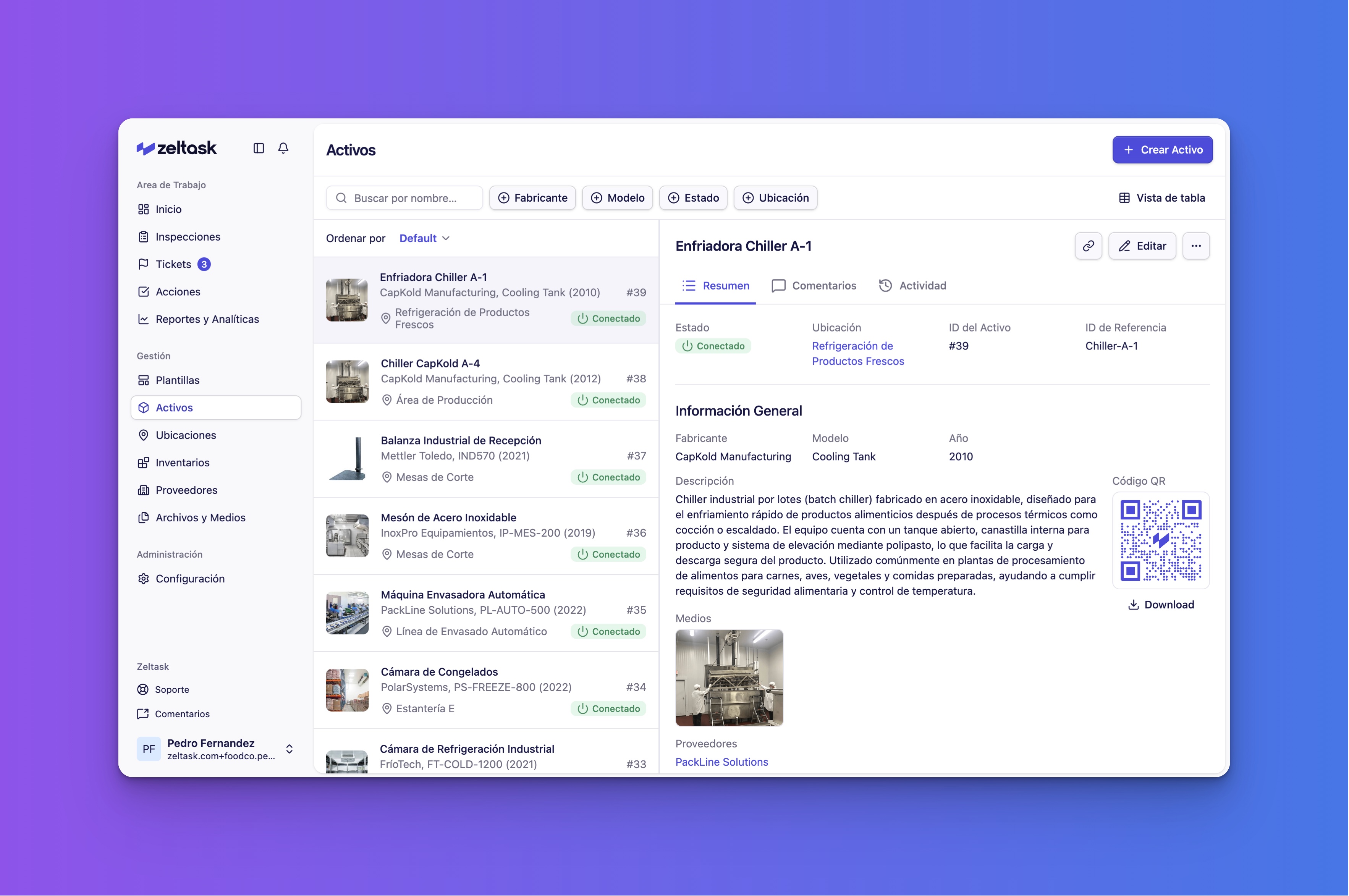
With Zeltask, frontline teams can report issues and submit observations directly from the shop floor. The Tickets module allows any team member to formally document a situation — a deviation, risk, or improvement opportunity — with photos, notes, and context. QR codes on equipment and locations enable immediate reporting without disrupting workflow.
Turn Observations into Structured Actions
When an issue is identified, Zeltask converts it into a trackable action with clear ownership, deadlines, priority levels, and status tracking. Actions can be linked to specific assets, locations, and inventory items — ensuring that improvement ideas don't remain good intentions.
Kaizen culture depends on this follow-through. The gap between identifying a problem and resolving it is where most improvement programs fail.
Standardize and Verify with Digital Inspections
Zeltask's Templates module allows teams to create standardized inspection and procedure checklists that embed best practices into daily work. Scheduled inspections verify that improvements are being followed. Conditions and triggers within templates can automatically create tickets or actions when specific responses indicate a problem — closing the loop between observation and response.
Maintain Traceability Across the Organization
Every action, inspection, and ticket in Zeltask preserves a complete record: who created it, when, what evidence was attached, and how it was resolved. This traceability supports organizational learning, prevents repeated mistakes, and demonstrates the impact of improvement efforts to leadership.
Scale Improvements Across Facilities
For multi-site manufacturers, Zeltask's template-based approach ensures that an improvement validated at one location can be deployed across others. Standardized procedures, recurring inspections, and consistent action categories create uniformity without sacrificing the flexibility that each plant needs.
Conclusion
Kaizen culture is not about achieving perfection — it is about committing to progress every day. When continuous improvement becomes embedded in daily routines, manufacturing teams build the operational discipline needed to improve safety, quality, efficiency, and resilience over time.
The key is moving beyond occasional improvement events toward a system where every frontline worker can identify problems, propose solutions, and see their ideas through to implementation. Connected operations platforms provide the structure that makes this sustainable at scale.
Want to understand the structured improvement cycle behind kaizen culture? Read our guide on What Is the Continuous Improvement Model? for a deeper look at the framework that drives daily progress in manufacturing.
Written by
Felipe Borja
Co-founder & CEO
Felipe Borja studied Business Administration at Adolfo Ibáñez University in Chile and earned an MBA from Leipzig University in Germany. At Zeltask, he is responsible for everything related to marketing and working with our clients.
Related Posts

Causal Factors: Prevent Recurring Problems in Manufacturing
Causal factors are the conditions and actions that directly contribute to manufacturing problems. Learn how to distinguish them from symptoms and root causes, identify them on the shop floor, and use them to build corrective actions that actually stick.

What Is the Continuous Improvement Model? A Guide for Manufacturing Teams
The continuous improvement model helps manufacturing teams identify inefficiencies, implement solutions, and sustain better practices over time. Learn how this structured approach drives operational excellence and how digital tools amplify its impact.

Empowering frontline teams: the key to operational excellence
Empowering frontline teams is key to solving problems where they actually occur: on the production floor. This article explores how clarity, autonomy, and digital systems turn daily observation into continuous improvement and real results.